

Most trekkers pass through Kathmandu on the way to the mountains and see little more than Thamel and the airport. That is a shame. The Kathmandu Valley holds one of the densest concentrations of living heritage anywhere in Asia, and UNESCO lists seven separate monument zones here as a single World Heritage Site, inscribed in 1979.
These are not museum pieces. Temples are in daily use, festivals still fill the squares and families live in the courtyards behind them. Two or three well-planned days are enough to see the highlights properly.
The three Durbar Squares
Until Nepal’s unification in the 18th century, the valley was divided between three rival Newar kingdoms: Kathmandu, Patan and Bhaktapur. Each built its own royal palace square, and each tried to outdo the others in temples, carving and metalwork.
- Kathmandu Durbar Square: the old royal palace of Hanuman Dhoka, multi-tiered temples and the Kumari Ghar, home of the living goddess.
- Patan Durbar Square: the most compact and refined of the three, with Krishna Mandir and the outstanding Patan Museum.
- Bhaktapur Durbar Square: the best-preserved old town, with the five-tiered Nyatapola temple, pottery square and quieter, car-free streets.
The Newars, the valley’s original urban people, built these cities with remarkable skill. Look for the carved wooden struts beneath temple roofs, the gilded metal doorways and the stone water spouts, or hiti, many of which still supply water to their neighbourhoods. Patan in particular is still a centre for traditional metal-casting and woodcarving workshops.
The 2015 earthquake damaged all three squares badly. Restoration has been slow and careful, using traditional materials and craftsmen, and most major monuments have now been rebuilt or stabilised. Some scaffolding remains, and seeing restoration in progress is part of the story.
In the Kathmandu Valley, heritage is not behind glass. You share the temple steps with people who come to pray every morning.
The great stupas: Swayambhunath and Boudhanath
Swayambhunath sits on a wooded hill west of the city, reached by a long stone stairway. Its whitewashed dome and painted eyes look out over the whole valley, and resident monkeys have earned it the nickname “Monkey Temple”. Come early for the morning circuit of pilgrims.
Boudhanath is one of the largest stupas in the world and the centre of Tibetan Buddhist life in Nepal. Monasteries, butter-lamp workshops and rooftop cafés surround it. Late afternoon, when pilgrims walk the kora clockwise around the dome, is the best time to visit.
Both stupas are built on the same plan: a whitewashed dome representing the universe, a square tower painted with the eyes of the Buddha, and thirteen tiers symbolising the steps to enlightenment. Prayer flags strung from the spire carry mantras out on the wind.
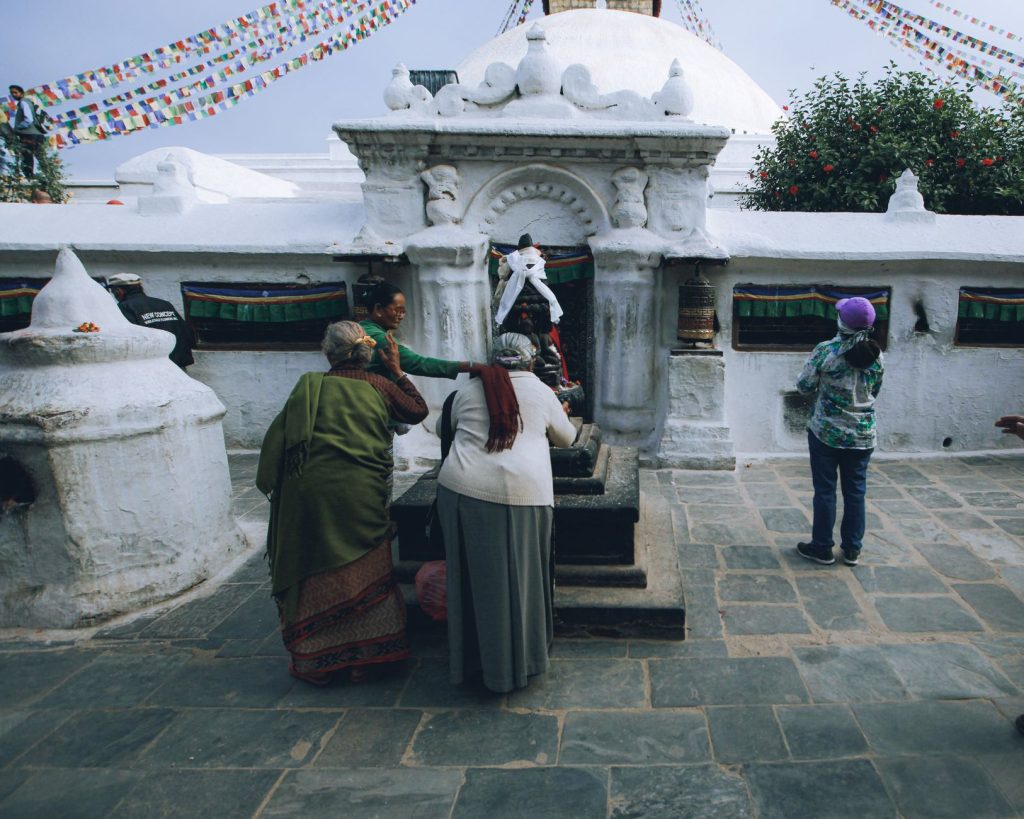
Swayambhunath also shows how intertwined Nepal’s faiths are. Hindu shrines stand beside Buddhist chortens on the hilltop, and Hindus and Buddhists alike come to worship. The same is true across the valley, where a single courtyard may hold both a Shiva lingam and a Buddhist stupa.
Pashupatinath and Changu Narayan
Pashupatinath, on the banks of the Bagmati River, is the most sacred Hindu temple in Nepal and one of the most important Shiva shrines in South Asia. Only Hindus may enter the main temple, but visitors can explore the wider complex and watch from the far bank. Open-air cremations take place on the riverside ghats; please observe respectfully and do not photograph grieving families.

Changu Narayan, on a ridge above Bhaktapur, is the oldest temple site in the valley, with inscriptions dating back to around the 5th century. It is quieter than the other sites and combines well with Bhaktapur and an overnight at Nagarkot for a Himalayan sunrise.
Swayambhunath and Boudhanath are also excellent places simply to sit. Find a rooftop café or a quiet step, order a cup of milk tea and watch the stream of pilgrims, monks, families and stray dogs go by. An hour spent this way often stays with people longer than any monument.
Planning your visit
Each site charges its own entrance fee for foreign visitors; there is no combined pass. At the time of writing, fees range from a few hundred rupees at Swayambhunath and Boudhanath to around NPR 1,000 at Kathmandu and Patan Durbar Squares and Pashupatinath, and around USD 15 at Bhaktapur. Keep your ticket: some are valid for repeat visits.
- Day one: Swayambhunath at sunrise, Kathmandu Durbar Square, then Patan in the afternoon.
- Day two: Pashupatinath in the morning, then Boudhanath for the evening kora.
- Day three: Bhaktapur and Changu Narayan, finishing with sunset at Nagarkot.
Traffic in the valley is heavy and the sites are spread out, so plan your days by geography rather than trying to tick everything off at once. Bhaktapur deserves a full day on its own if you can spare it, ideally with an overnight stay so you can see the squares quietly in the early morning and evening.
- Start early: light is better, crowds are thinner and the temples are busiest with local worshippers.
- Try a Newari lunch of beaten rice, spiced meats and lentil patties, and Bhaktapur’s famous juju dhau yoghurt.
- Carry small notes for entrance fees, donations and snacks.

u003cstrongu003eDress and etiquetteu003c/strongu003ernrnCover shoulders and knees at temples, remove shoes where asked, walk clockwise around stupas and prayer wheels, and ask before photographing people. Leather items are not allowed inside some Hindu temples.
Seeing it with a guide
You can visit every site independently, but a good local guide transforms the experience: who the deities are, why a temple faces the way it does, which festival you have just walked into. Our Kathmandu Valley Heritage Tour covers the main monument zones with a licensed guide and private transport, and our Bhaktapur and Nagarkot tour adds an overnight stay and a mountain sunrise.
Time your visit around a festival if you can. Indra Jatra in Kathmandu, Bisket Jatra in Bhaktapur and Dashain across the valley bring the squares alive in a way no guidebook can describe. Dates follow the lunar calendar and change each year, so ask us when you start planning.