





Manaslu Circuit Trekking
 6 spring departures left
-
 Manaslu Region, Gorkha, Nepal

Cross the Larkya La pass at 5,106 m

Tibetan Buddhist villages of Nubri

Close views of Manaslu (8,163 m)

Quiet restricted-area trail
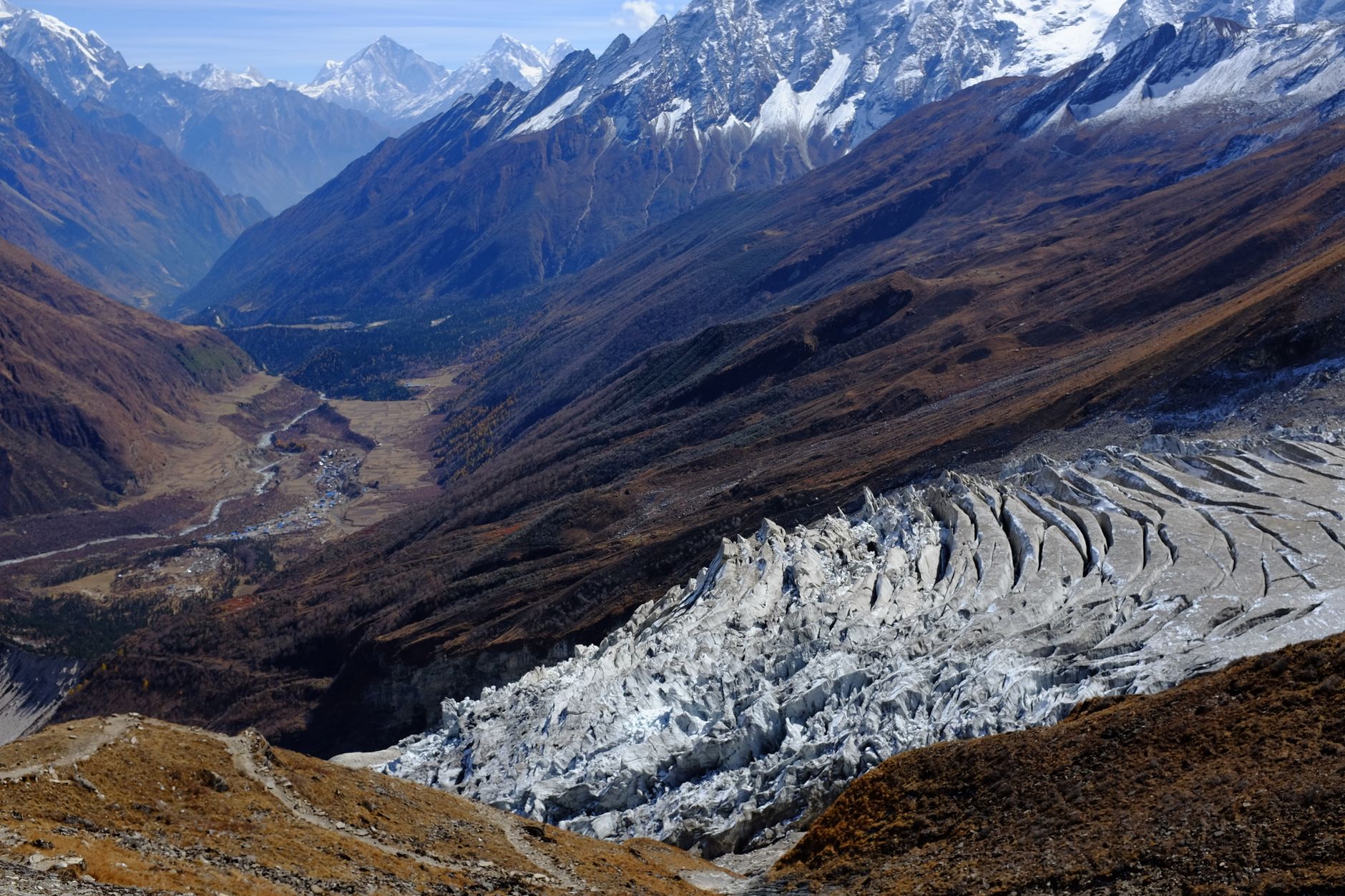
The Manaslu Circuit is a full loop around Manaslu, at 8,163 m the eighth-highest mountain in the world. It is often compared with the Annapurna Circuit of a few decades ago: quieter trails, simple teahouses and a strong sense of remoteness, because the upper valley is a restricted area that can only be visited with a licensed guide and special permit.
The trek starts low, in the warm, terraced gorge of the Budhi Gandaki river, with waterfalls, suspension bridges and Gurung villages. As you climb through Deng, Namrung and Lho, the culture shifts to Tibetan Buddhism, with carved mani stones, monasteries and prayer flags, and the great white wall of Manaslu comes into view above Samagaun.
After an acclimatisation day at Samagaun, with an optional hike towards Manaslu Base Camp or Pungyen Gompa, the route continues to Samdo near the Tibetan border and the stone shelters of Dharamsala. The crossing of the Larkya La (5,106 m) is a long, demanding day with big views of Himlung, Cheo Himal and the Annapurna II massif, before a descent into the green meadows of Bimthang.
The circuit then joins the Marsyangdi valley at Dharapani, from where we drive back to Kathmandu. Our 14-day itinerary allows a steady ascent and suits fit trekkers with some previous multi-day hiking experience.
-
 Duration
 14 Days
-
Nights
13 Nights
-
 Difficulty
 Hard
-
 Max.Elevation
 5,106 m (16,752 ft)
-
 Accomodation
 Hotel & Tea house
-
 Meals
Meals Breakfast, Lunch & Dinner during the trek
-
 Group Size
 1 - 12 Travelers
-
 Best Season
 Mar - May, Sep - Nov
-
 Starting Point
 Kathmandu
-
 Ending Point
 Kathmandu
-
 Permit
 Manaslu Restricted Area Permit, Manaslu Conservation Area Permit (MCAP), Annapurna Conservation Area Permit (ACAP)
-
 Trip Type
 Private or Group
The Manaslu Circuit is a full loop around Manaslu, at 8,163 m the eighth-highest mountain in the world. It is often compared with the Annapurna Circuit of a few decades ago: quieter trails, simple teahouses and a strong sense of remoteness, because the upper valley is a restricted area that can only be visited with a licensed guide and special permit.
The trek starts low, in the warm, terraced gorge of the Budhi Gandaki river, with waterfalls, suspension bridges and Gurung villages. As you climb through Deng, Namrung and Lho, the culture shifts to Tibetan Buddhism, with carved mani stones, monasteries and prayer flags, and the great white wall of Manaslu comes into view above Samagaun.
After an acclimatisation day at Samagaun, with an optional hike towards Manaslu Base Camp or Pungyen Gompa, the route continues to Samdo near the Tibetan border and the stone shelters of Dharamsala. The crossing of the Larkya La (5,106 m) is a long, demanding day with big views of Himlung, Cheo Himal and the Annapurna II massif, before a descent into the green meadows of Bimthang.
The circuit then joins the Marsyangdi valley at Dharapani, from where we drive back to Kathmandu. Our 14-day itinerary allows a steady ascent and suits fit trekkers with some previous multi-day hiking experience.


Itinerary
A 14-day loop from Kathmandu, trekking up the Budhi Gandaki to Samagaun, over the Larkya La to Bimthang and out to Dharapani in the Marsyangdi valley.
Arrival in Kathmandu
-
 Max Altitude
1,400 m
Max Altitude
1,400 m
-
 Accommodation
Hotel
Accommodation
Hotel
- Transfer Airport to hotel, approx. 30 min
Welcome to Nepal. Our team meets you at Tribhuvan International Airport and transfers you to your hotel. Later, your guide will brief you on the trek, check your equipment and collect the passport copies and photos needed for the restricted area permit. Any missing gear can be bought or rented in Thamel. Rest well, as the next morning starts early with a long drive into the hills.
Day highlights
-
 Airport welcome
 -
Trek briefing and permit paperwork
Drive from Kathmandu to Machha Khola
-
Max Altitude
930 m
-
Accommodation
Guesthouse (Basic Lodge/Community Lodge)
-
Meals
Breakfast, Lunch, and Dinner Included
We leave Kathmandu early and follow the Prithvi Highway west before turning north towards Arughat and Soti Khola. Beyond Arughat the road becomes rough and narrow as it follows the Budhi Gandaki river upstream, passing terraced fields and small villages. The day ends at Machha Khola, whose name means Fish River, a small village with simple teahouses. It is a long and bumpy drive, but it takes you straight to the start of the trail.
Day highlights
-
Drive along the Budhi Gandaki
-
Arrival at the trailhead
Trek from Machha Khola to Jagat
-
Max Altitude
1,340 m
-
Accommodation
Guesthouse (Basic Lodge/Community Lodge)
-
Meals
Breakfast, Lunch, and Dinner Included
The first trekking day follows the Budhi Gandaki through a narrow, steep-sided valley. The trail climbs and drops along the river, crossing several suspension bridges and passing Tatopani, where natural hot springs feed a small bathing spot. After Dobhan and Yaru Khola we reach Jagat, a paved stone village where the Manaslu restricted area permit is checked. The lower valley is warm, so start early and carry plenty of water.
Day highlights
-
Tatopani hot springs
-
Restricted area checkpoint at Jagat
Trek from Jagat to Deng
-
Max Altitude
1,860 m
-
Accommodation
Guesthouse (Basic Lodge/Community Lodge)
-
Meals
Breakfast, Lunch, and Dinner Included
From Jagat the trail climbs to Salleri and Sirdibas, where the first mani walls and chortens appear. We pass Philim, a large Gurung village, and the junction where the trail to the Tsum Valley branches off. The gorge then narrows dramatically, with the path cut into cliffs above the river and bamboo forest on the slopes. After Ekle Bhatti and several bridges, we arrive at the small settlement of Deng, the gateway to the Nubri region.
Day highlights
-
Gurung village of Philim
-
Dramatic Budhi Gandaki gorge
Trek from Deng to Namrung
-
Max Altitude
2,630 m
-
Accommodation
Guesthouse (Basic Lodge/Community Lodge)
-
Meals
Breakfast, Lunch, and Dinner Included
After crossing the river, the trail climbs to Rana and Bihi Phedi, with Buddhist carvings and prayer flags becoming more frequent. We continue through forest and small villages such as Ghap, where you may catch views of Shringi Himal. The last section climbs through a lovely forest of rhododendron and fir to Namrung, a well-kept village with good teahouses, a small museum and a police checkpoint. On clear afternoons, Siringi and Ganesh Himal can be seen from here.
Day highlights
-
Mani walls and prayer flags
-
Forest walk to Namrung
Trek from Namrung to Lho
-
Max Altitude
3,180 m
-
Accommodation
Guesthouse (Basic Lodge/Community Lodge)
-
Meals
Breakfast, Lunch, and Dinner Included
A shorter day that helps acclimatisation. The trail passes through Banjam and Lihi, with barley fields, stone houses and long mani walls showing the Tibetan culture of Nubri. The valley opens and the views grow bigger with every step. We stop at Lho, a village with a large monastery, Ribung Gompa, set on a ridge. From Lho, the sunset and sunrise views of Manaslu are among the best on the whole circuit, so have your camera ready.
Day highlights
-
Ribung Gompa at Lho
-
Sunset views of Manaslu
Trek from Lho to Samagaun
-
Max Altitude
3,530 m
-
Accommodation
Guesthouse (Basic Lodge/Community Lodge)
-
Meals
Breakfast, Lunch, and Dinner Included
After an early look at Manaslu glowing at sunrise, we walk to Shyala, a village surrounded by peaks including Himalchuli and Ngadi Chuli. The trail then crosses open pastures to Samagaun (also called Sama Gaon), the largest village in the upper valley. Samagaun sits beneath the glaciers of Manaslu and has a strong Tibetan character, with a monastery, yak herds and potato fields. The walk is short, leaving the afternoon free to rest and explore.
Day highlights
-
Shyala village views
-
Tibetan-style Samagaun
Acclimatisation day at Samagaun
-
Max Altitude
3,530 m
-
Accommodation
Guesthouse (Basic Lodge/Community Lodge)
-
Meals
Breakfast, Lunch, and Dinner Included
This rest day is important before going higher. Staying active helps acclimatisation, so we take a hike and return to sleep at the same altitude. Popular choices are the walk to Birendra Tal, a glacial lake at the foot of Manaslu, the climb to Pungyen Gompa with close views of the Manaslu glacier, or a longer, tougher hike towards Manaslu Base Camp (about 4,800 m). Your guide will suggest the best option based on the group’s energy and the weather.
Day highlights
-
Birendra Tal glacial lake
-
Pungyen Gompa or Manaslu Base Camp hike
Trek from Samagaun to Samdo
-
Max Altitude
3,860 m
-
Accommodation
Guesthouse (Basic Lodge/Community Lodge)
-
Meals
Breakfast, Lunch, and Dinner Included
An easy walk along the widening Budhi Gandaki valley, past juniper and birch scrub and yak pastures. After crossing a bridge, we climb a short way to Samdo, a remote village of Tibetan origin close to the border. The short day gives your body time to adjust to the altitude. In the afternoon, a short hike above the village offers views of the surrounding peaks and the route to the Tibetan border.
Day highlights
-
Border village of Samdo
-
High yak pastures
Trek from Samdo to Dharamsala (Larkya Phedi)
-
Max Altitude
4,460 m
-
Accommodation
Guesthouse (Basic Lodge/Community Lodge)
-
Meals
Breakfast, Lunch, and Dinner Included
The trail crosses a stream and climbs steadily past the Larkya glacier moraine. The landscape turns barren and rocky, with blue sheep sometimes seen on the slopes. We reach Dharamsala, also called Larkya Phedi, a small group of basic lodges at the foot of the pass. It is the highest overnight stop of the trek, and conditions are cold and simple. Have an early dinner and go to bed early for tomorrow’s pre-dawn start.
Day highlights
-
Larkya glacier moraine
-
Highest overnight stop
Cross the Larkya La (5,106 m) to Bimthang
-
Max Altitude
5,106 m
-
Accommodation
Guesthouse (Basic Lodge/Community Lodge)
-
Meals
Breakfast, Lunch, and Dinner Included
The big day. We start around 4 am and climb gradually over moraine and past small frozen lakes to the prayer-flagged Larkya La. From the top, the views of Himlung Himal, Cheo Himal, Kang Guru and Annapurna II are unforgettable. The descent to the west is steep and can be icy, so take care. The trail eases lower down and reaches the wide meadows of Bimthang, with Manaslu’s northern face and glaciers behind. This is the longest day of the trek.
Day highlights
-
Larkya La summit panorama
-
Bimthang meadows below Manaslu
Trek from Bimthang to Dharapani
-
Max Altitude
3,720 m
-
Accommodation
Guesthouse (Basic Lodge/Community Lodge)
-
Meals
Breakfast, Lunch, and Dinner Included
We descend through pine and rhododendron forest, crossing the Dudh Khola and passing Hampuk, Yak Kharka and Karche. The greenery returns quickly and the air feels warm and rich after the high pass. Past Gho and Tilije, a Gurung village, the trail reaches Dharapani, where it joins the Annapurna Circuit in the Marsyangdi valley. Your ACAP permit is checked here. Enjoy a relaxed final trekking evening with the team.
Day highlights
-
Forest descent from Bimthang
-
Joining the Annapurna Circuit
Drive from Dharapani to Kathmandu
-
Max Altitude
1,860 m
-
Accommodation
Hotel
-
Meals
Breakfast Included
We drive by jeep down the Marsyangdi valley past Tal, Chamje and Syange to Besisahar, the headquarters of Lamjung district. The road is rough in its upper part, with waterfalls and steep valley walls. From Besisahar we continue on a better road to Dumre and along the Prithvi Highway back to Kathmandu. It is a long travel day, and you will reach your hotel in the evening.
Day highlights
-
Drive through the Marsyangdi valley
-
Return to Kathmandu
Departure from Kathmandu
-
Max Altitude
1,400 m
-
Meals
Breakfast Included
- Transfer Hotel to airport, approx. 30 min
Your Manaslu journey ends today. Depending on your flight time, you may have a few hours for shopping or a visit to a heritage site such as Boudhanath Stupa. A member of our team will drive you to Tribhuvan International Airport about three hours before your flight. We hope to see you again on another Himalayan adventure.
Day highlights
-
Free time before your flight
-
Airport drop-off
Maps
Where this trip takes you.
Fixed Departures
Set group departures below. Private dates can be arranged on any day that suits you.
Oct 20 - Nov 2, 2026
-
 Group Joining
 -
 Guaranteed
From $1,490 /Person
Book nowNov 5 - Nov 18, 2026
-
Group Joining
-
Guaranteed
From $1,490 /Person
Book nowNov 20 - Dec 3, 2026
-
Group Joining
-
Guaranteed
From $1,490 /Person
Book nowMar 5 - Mar 18, 2027
-
Group Joining
-
Available
From $1,490 /Person
Book nowMar 20 - Apr 2, 2027
-
Group Joining
-
Available
From $1,490 /Person
Book nowApr 5 - Apr 18, 2027
-
Group Joining
-
Available
From $1,490 /Person
Book nowApr 20 - May 3, 2027
-
Group Joining
-
Available
From $1,490 /Person
Book nowMay 5 - May 18, 2027
-
Group Joining
-
Available
From $1,490 /Person
Book nowMay 20 - Jun 2, 2027
-
Group Joining
-
Available
From $1,490 /Person
Book nowSep 5 - Sep 18, 2027
-
Group Joining
-
Available
From $1,490 /Person
Book nowSep 20 - Oct 3, 2027
-
Group Joining
-
Available
From $1,490 /Person
Book nowAvailability
Join a set group departure, or ask us for a private date that suits you.
Didn’t find a suitable date? Contact us with your dates and preferences.
Inclusions & exclusions
What the trip price covers, and what to budget for separately.
What’s included
- Airport transfers – Pick-up and drop-off at Kathmandu airport
- Kathmandu hotel – 2 nights in a standard hotel with breakfast
- Ground transport – Kathmandu to Machha Khola and Dharapani to Kathmandu by local jeep or bus
- Trek accommodation – 11 nights in teahouses on a twin-sharing basis
- Meals on trek – Breakfast, lunch and dinner during the trek
- Licensed guide – English-speaking trekking guide, with salary, food, lodging and insurance
- Permits – Manaslu restricted area permit, MCAP and ACAP
- First aid – Basic first-aid kit and pulse oximeter carried by your guide
- Government taxes – All applicable taxes and service charges
Not included
- International flights – Flights to and from Nepal
- Nepal visa – Available on arrival at Kathmandu airport
- Travel insurance – Must cover trekking up to 5,500 m and helicopter evacuation
- Porter – Available on request at extra cost
- Private jeep – Upgrade from shared transport at extra cost
- Kathmandu meals – Lunch and dinner in Kathmandu
- Personal expenses – Drinks, snacks, hot showers, Wi-Fi and battery charging
- Tips – For your guide, porter and driver
Why this trip stands out
-
 It is a true circuit, so you see new scenery every day from subtropical gorge to high pass.
 -
Restricted-area status keeps trekker numbers far lower than on the Everest or Annapurna trails.
-
You pass through rarely visited Gurung and Tibetan Buddhist villages with living monasteries.
-
The Larkya La crossing at 5,106 m is one of the great pass days in the Himalaya.
-
The itinerary builds in a gradual ascent with a stop at Lho and a rest day at Samagaun.
Good to know
Practical information to help you prepare for this trip.

Essential Packing Guide
Prepare for hot lower valleys and freezing nights near the pass.
- Clothing: Quick-dry layers, fleece, down jacket, waterproof shell, warm hat and gloves.
- Footwear: Sturdy waterproof boots; microspikes are useful when the pass is icy.
- Gear: Sleeping bag rated to about -15°C, trekking poles, headlamp and daypack.
- Health: Water purification, sunscreen, lip balm and personal medicines.

Permits
The Manaslu Restricted Area Permit can only be issued through a registered trekking agency, with a licensed guide. You also need the MCAP and ACAP. We need a scan of your passport and visa to apply, and the original passport must be carried on the trek.

Altitude & Acclimatisation
The route sleeps above 3,500 m for several nights and crosses 5,106 m. The itinerary builds in a short day to Lho and a rest day at Samagaun. Walk slowly, drink three to four litres of water a day and tell your guide about any symptoms straight away.

Accommodation and Meals
Teahouses are family-run and basic, with dal bhat, noodles, potatoes, soups and Tibetan bread on most menus. Food and drinks get more expensive as you climb, since supplies are carried in by mule or porter.

Travel Insurance
Insurance covering trekking to 5,500 m, medical costs and helicopter evacuation is required for this trek. Please share your policy details with us before departure.
FAQs
Answers to the questions travellers ask us most about this trip.
Can I trek the Manaslu Circuit solo?
You cannot trek it independently. A licensed guide from a registered agency is mandatory. Nepal’s Department of Immigration announced in March 2026 that a single trekker can now obtain the restricted area permit, which previously required at least two foreigners. We confirm the current rule with the authorities when we apply for your permit.
Which permits are required and how much do they cost?
You need three permits: the Manaslu Restricted Area Permit (about USD 100 for the first 7 days in September to November, or USD 75 from December to August, plus a daily fee for extra days), the Manaslu Conservation Area Permit (NPR 3,000) and the Annapurna Conservation Area Permit (NPR 3,000) for the exit through Dharapani. All are included in our price.
What is the highest point and where is the highest overnight stop?
The highest point is the Larkya La at 5,106 m. The highest overnight stop is Dharamsala (Larkya Phedi) at around 4,460 m.
What if bad weather closes the Larkya La?
Heavy snow can close the pass, especially in winter and early spring. If it is unsafe, your guide may wait a day or turn back via the same route. We recommend adding a spare day to your travel plans after the trek.
What are the teahouses like?
Lodges are simpler than on the Everest or Annapurna routes. Expect twin rooms with thin walls, shared toilets and limited hot water. At Dharamsala the rooms are especially basic and cold, so a warm sleeping bag is essential.
When is the best time to trek?
Autumn (September to November) and spring (March to May) are the best seasons. Autumn usually has the clearest skies, while spring brings flowering rhododendrons. Winter can close the pass, and the monsoon brings landslides on the lower trail.
Is there internet and phone signal on the trail?
Some villages have Wi-Fi for a fee and mobile signal is available in parts of the lower valley and at Samagaun, but coverage is unreliable higher up. Treat the trek as a chance to switch off.
Traveller reviews
Read what travellers say about this trip, or share your own experience.
Plan your journey
Price Starts From
$1,490
$1,650
-
 PAX
COST PER PERSON
PAX
COST PER PERSON
- 1 - 1 Traveler $1,490
- 2 - 5 Travelers $1,320
- 6 - 12 Travelers $1,190
**Discounts are solely based on your group size. We do not add anyone to your group.
-
Reserve now and pay later
-
Experienced & Knowledgeable Guides
-
Personalized & Customer-centric Service
-
Sustainable & Environmental Responsibility


Bishal plans these departures and usually replies within four hours.
 Free cancellation up to 21 days before departure
Let’s Plan Your Himalayan Journey
Whether it’s a trek, tour, or custom adventure, we’re here to help you plan the perfect experience in Nepal.ss


Send us an Inquiry
Tell us about your dream trip and we’ll get back to you within 24 hours.

Explore more packages
Carefully designed trekking itineraries led by experienced local guides, from beginner-friendly hikes to legendary Himalayan expeditions.
Explore all treks
Mera Peak Climbing
-
17 Days
-
Hard
-
6,476 m (21,247 ft)
Climb Mera Peak (6,476 m), Nepal's highest trekking peak, via the remote Hinku valley and...

Upper Mustang Circuit Trek
-
18 Days
-
Hard
-
4,280 m (14,042 ft)
A full loop of the old Kingdom of Lo: up the west bank via Dhakmar...

Everest Panorama Trek
-
10 Days
-
Medium
-
3,880 m (12,730 ft)
A short, lower-altitude taste of the Khumbu: Namche Bazaar, Tengboche Monastery and the Sherpa village...
Everest Three High Pass Trek
-
19 Days
-
Hard
-
5,545 m (18,192 ft)
The ultimate Khumbu circuit: cross Kongma La, Cho La and Renjo La, visit Everest Base...


