

Upper Mustang Circuit Trek
 4 spring departures left
-
 Mustang Region, Nepal

Remote east bank: Yara, Tangge, Tetang

Luri Gompa cave monastery paintings

Paa La and Gyu La crossings to Muktinath

Chhoser caves and Lo Manthang
The Upper Mustang Circuit Trek is for walkers who want more than the standard there-and-back route. Instead of returning the way you came, this loop covers both sides of the Kali Gandaki, so almost every night is in a different village and the second half of the trek leaves the road behind almost entirely.
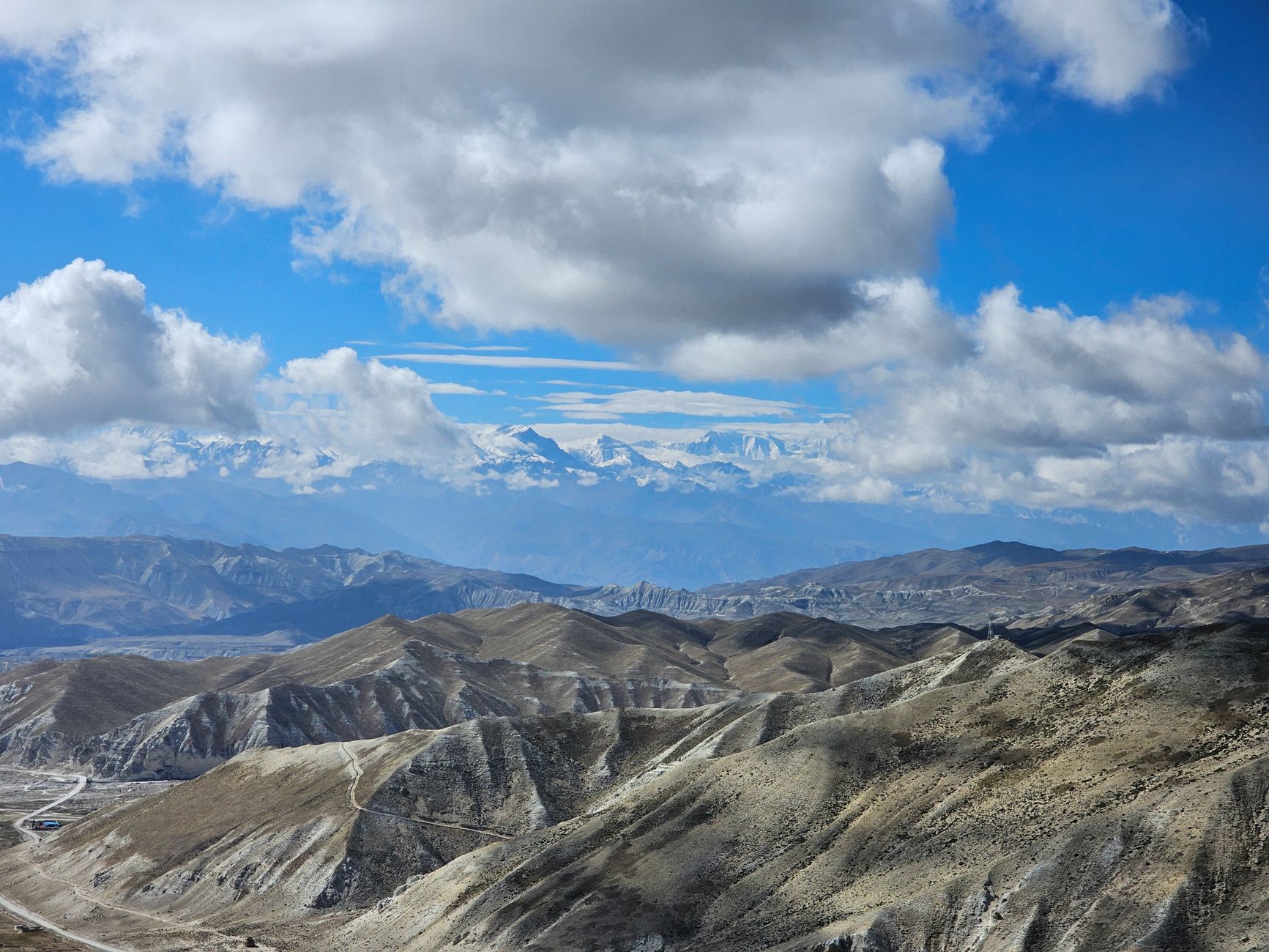
The outward leg follows the old trade route through Chele, Syangboche and Ghami, then detours to Dhakmar and its blood-red cliffs and over the high ground past Ghar Gompa into Lo Manthang. After two nights in the walled city, including a trip out to the Chhoser cave complex, we cross the river to the quieter east bank. Here the villages of Dhi, Yara and Tangge see only a fraction of Mustang’s visitors. A dedicated day takes you up to Luri Gompa, a cave monastery with centuries-old Buddhist wall paintings.
The final stretch is the wildest part of the circuit: a long, uninhabited crossing of the Paa La, at around 4,180 m, to Tetang, and then over the Gyu La, at about 4,077 m, to the pilgrimage town of Muktinath before descending to Jomsom. Expect longer days, fewer lodges and bigger landscapes than on the classic route.
Elevate Trek arranges the Restricted Area Permit, ACAP, Jomsom flights, a licensed guide and porters, starting and ending in Kathmandu with nights in our home town of Pokhara.
-
 Duration
 18 Days
-
Nights
17 Nights
-
 Difficulty
 Hard
-
 Max.Elevation
 4,280 m (14,042 ft)
-
 Accomodation
 Hotel, Lodge & Tea house
-
 Meals
Meals Breakfast, Lunch & Dinner during the trek
-
 Group Size
 1 - 12 Travelers
-
 Best Season
 Apr - Jun, Sep - Oct
-
 Starting Point
 Kathmandu
-
 Ending Point
 Kathmandu
-
 Permit
 Upper Mustang Restricted Area Permit, Annapurna Conservation Area Permit (ACAP)
-
 Trip Type
 Private or Group
The Upper Mustang Circuit Trek is for walkers who want more than the standard there-and-back route. Instead of returning the way you came, this loop covers both sides of the Kali Gandaki, so almost every night is in a different village and the second half of the trek leaves the road behind almost entirely.
The outward leg follows the old trade route through Chele, Syangboche and Ghami, then detours to Dhakmar and its blood-red cliffs and over the high ground past Ghar Gompa into Lo Manthang. After two nights in the walled city, including a trip out to the Chhoser cave complex, we cross the river to the quieter east bank. Here the villages of Dhi, Yara and Tangge see only a fraction of Mustang’s visitors. A dedicated day takes you up to Luri Gompa, a cave monastery with centuries-old Buddhist wall paintings.
The final stretch is the wildest part of the circuit: a long, uninhabited crossing of the Paa La, at around 4,180 m, to Tetang, and then over the Gyu La, at about 4,077 m, to the pilgrimage town of Muktinath before descending to Jomsom. Expect longer days, fewer lodges and bigger landscapes than on the classic route.
Elevate Trek arranges the Restricted Area Permit, ACAP, Jomsom flights, a licensed guide and porters, starting and ending in Kathmandu with nights in our home town of Pokhara.


Itinerary
An 18-day loop that climbs the west bank of the Kali Gandaki to Lo Manthang via Dhakmar and Ghar Gompa, then returns down the remote east bank via Yara, Luri Gompa, Tangge, Tetang and Muktinath.
Arrival in Kathmandu
-
 Max Altitude
1,350 m
Max Altitude
1,350 m
-
 Accommodation
Hotel
Accommodation
Hotel
- Transfer Airport to hotel, approx. 30 min
Our team meets you at Tribhuvan International Airport and transfers you to your hotel in Thamel. After you have had time to rest, your guide runs through the circuit route with you, checks your equipment list and collects the passport copies and photos needed for the Restricted Area Permit. This trek has some long, remote days on the east bank, so it is a good moment to ask questions about fitness, water and gear. Spend the evening exploring Thamel or catching up on sleep.
Day highlights
-
 Airport welcome
 -
Circuit briefing and permit paperwork
Kathmandu to Pokhara
-
Max Altitude
822 m
-
Accommodation
Hotel
-
Meals
Breakfast Included
We head west to Pokhara by tourist bus along the Prithvi Highway, or by a short flight if you prefer. The road follows the Trishuli River through terraced hills and small bazaar towns. Pokhara is where our team is based, and the relaxed lakeside makes a gentle start to the trip. In the afternoon you can walk along Phewa Lake or hire a boat, and on a clear evening the summit of Machhapuchhre glows above the town. Your guide confirms permits and flight tickets for the morning.
Day highlights
-
Lakeside Pokhara
-
Views of Machhapuchhre
Fly to Jomsom, trek to Kagbeni
-
Max Altitude
2,810 m
-
Accommodation
Guesthouse (Basic Lodge/Community Lodge)
-
Meals
Breakfast, Lunch, and Dinner Included
We take the early flight from Pokhara to Jomsom, a spectacular hop through the Kali Gandaki gorge between Dhaulagiri and Annapurna I. From Jomsom we walk up the broad gravel riverbed to Kagbeni, an easy half-day that lets you get used to the thinner, drier air. Kagbeni is an atmospheric village of narrow passages, prayer wheels and a large red monastery, sitting where the Jhong Khola meets the Kali Gandaki. In the afternoon you can explore the old village and watch the wind pick up along the valley.
Day highlights
-
Flight between two 8,000 m peaks
-
Old village of Kagbeni
Kagbeni to Chele
-
Max Altitude
3,050 m
-
Accommodation
Guesthouse (Basic Lodge/Community Lodge)
-
Meals
Breakfast, Lunch, and Dinner Included
After checking in at the restricted-area checkpoint, we follow the Kali Gandaki north past Tangbe, a cluster of white houses and chortens among apple orchards, and on to Chhusang. Look out for the ancient cave dwellings cut high into the cliffs on both sides of the river. After crossing the Kali Gandaki close to a natural rock tunnel, we make a steep final climb to Chele. The villagers here are of Tibetan origin, and from this point on the culture, architecture and food all shift noticeably towards Tibet.
Day highlights
-
Restricted-area checkpoint
-
Cliff caves of Chhusang
Chele to Syangboche
-
Max Altitude
3,735 m
-
Accommodation
Guesthouse (Basic Lodge/Community Lodge)
-
Meals
Breakfast, Lunch, and Dinner Included
We climb out of Chele above a deep gorge to Taklam La, at about 3,624 m, then continue to Dajori La, at about 3,735 m, with views back to Nilgiri and across to Tilicho Peak. The trail drops to Samar, a green oasis of poplars and a good lunch stop, then weaves in and out of side valleys, past chortens and small shrines, before reaching the few lodges at Syangboche. It is a long, dry day with plenty of climbing, so steady pacing and regular water breaks are key.
Day highlights
-
Taklam La and Dajori La
-
Lunch in the Samar oasis
Syangboche to Ghami
-
Max Altitude
4,010 m
-
Accommodation
Guesthouse (Basic Lodge/Community Lodge)
-
Meals
Breakfast, Lunch, and Dinner Included
A climb to a prayer-flag-covered ridge is followed by the crossing of the Nyi La, at roughly 4,000 m, traditionally the southern edge of the Kingdom of Lo. On a clear morning the Annapurna range stretches along the southern horizon. We descend gradually across wide, barren slopes into Ghami, a large village of whitewashed houses set among barley fields. In the afternoon you can walk out to see the famous long mani wall, one of the longest in Mustang, just beyond the village.
Day highlights
-
Nyi La, gateway to Lo
-
Ghami mani wall
Ghami to Dhakmar
-
Max Altitude
3,820 m
-
Accommodation
Guesthouse (Basic Lodge/Community Lodge)
-
Meals
Breakfast, Lunch, and Dinner Included
A deliberately short day that leaves the main trail. We cross the Ghami Khola and head up a side valley to Dhakmar, a small farming village that sits right under a wall of eroded red cliffs. The cliffs are riddled with caves, and local legend says their colour comes from the blood of a demon killed by Guru Rinpoche. Arriving by lunchtime gives you the afternoon to explore the village, photograph the cliffs as the light changes and rest ahead of tomorrow’s high crossing.
Day highlights
-
Red cliffs of Dhakmar
-
Relaxed acclimatisation afternoon
Dhakmar to Lo Manthang via Ghar Gompa
-
Max Altitude
4,280 m
-
Accommodation
Guesthouse (Basic Lodge/Community Lodge)
-
Meals
Breakfast, Lunch, and Dinner Included
We climb out of the Dhakmar valley to Lo Gekar, known as Ghar Gompa, a small, very old monastery associated with Guru Rinpoche and filled with painted rock carvings. From here the trail climbs across high grazing land to the Chogo La, at around 4,280 m, the highest point of the circuit. The reward is a sweeping view north over the plateau of Lo. We descend gradually and approach Lo Manthang from the west, entering the walled city by its main gate in the afternoon.
Day highlights
-
Ghar Gompa (Lo Gekar)
-
Chogo La, highest point
-
Arrival in Lo Manthang
Lo Manthang and the Chhoser caves
-
Max Altitude
3,840 m
-
Accommodation
Guesthouse (Basic Lodge/Community Lodge)
-
Meals
Breakfast, Lunch, and Dinner Included
Today we explore the city and its surroundings. In the morning we visit Jampa Lhakhang with its mandala murals, the grand hall of Thubchen Gompa and the working Chode Gompa, and walk past the royal palace. Later we travel north by jeep or pony up the Chhoser valley to the Jhong cave complex, a multi-storey network of rooms cut into the cliff, and the cliffside Nyphu Gompa. We return to Lo Manthang for a second night inside the walls. Take plenty of water and sun protection, as the valley is dry and exposed.
Day highlights
-
Jampa and Thubchen gompas
-
Jhong cave complex at Chhoser
Lo Manthang to Yara
-
Max Altitude
3,900 m
-
Accommodation
Guesthouse (Basic Lodge/Community Lodge)
-
Meals
Breakfast, Lunch, and Dinner Included
We leave the walled city and head south-east, crossing a ridge before dropping steeply to the Kali Gandaki near Dhi, a village of fields and orchards on the valley floor. After crossing the river we climb the east bank to Yara, which sits on a terrace facing huge, fluted cliffs full of caves. From here on the trail is well away from the main road and you are likely to meet few other trekkers. The evening light on the cliffs opposite Yara is one of the highlights of the east bank.
Day highlights
-
Crossing to the east bank at Dhi
-
Cave-lined cliffs of Yara
Day hike to Luri Gompa
-
Max Altitude
4,000 m
-
Accommodation
Guesthouse (Basic Lodge/Community Lodge)
-
Meals
Breakfast, Lunch, and Dinner Included
A day hike up the valley from Yara via Ghara to Luri Gompa, a cave monastery set into a cliff face. Inside, a painted stupa and wall paintings are thought to date back to around the 13th to 15th centuries and are among the finest early Buddhist art in Mustang. We also visit the small Tashi Kabum cave shrine if access allows. The trail climbs gradually through dramatic eroded scenery, and we return to Yara for the night, giving you another useful acclimatisation day before the long crossings ahead.
Day highlights
-
Luri Gompa cave paintings
-
Ghara village
Yara to Tangge
-
Max Altitude
3,850 m
-
Accommodation
Guesthouse (Basic Lodge/Community Lodge)
-
Meals
Breakfast, Lunch, and Dinner Included
We descend to the river and follow a trail through an eerie landscape of eroded ridges and canyons, crossing several dry streambeds and a couple of small passes. Tangge is one of the most isolated villages in Mustang: a tight cluster of whitewashed houses, fields of barley and buckwheat, and a large chorten, set beside the river beneath huge cliffs. There is very little between Yara and Tangge, so the guide makes sure everyone carries enough water and snacks for the day.
Day highlights
-
Remote canyon country
-
Isolated village of Tangge
Tangge to Tetang via Paa La
-
Max Altitude
4,180 m
-
Accommodation
Guesthouse (Basic Lodge/Community Lodge)
-
Meals
Breakfast, Lunch, and Dinner Included
The toughest day of the circuit. We make a long, steady climb from Tangge onto a high, uninhabited plateau and cross the Paa La, at around 4,180 m, with wide views over the Kali Gandaki and the Damodar and Annapurna ranges. There are no villages or lodges along the way, so we carry a packed lunch. A long descent brings us to Tetang, a village of stone houses squeezed into a narrow gorge near Chhusang. Expect to feel tired tonight; the good news is that the hardest part is behind you.
Day highlights
-
Paa La crossing
-
Wild, uninhabited plateau
Tetang to Muktinath via Gyu La
-
Max Altitude
4,077 m
-
Accommodation
Guesthouse (Basic Lodge/Community Lodge)
-
Meals
Breakfast, Lunch, and Dinner Included
We climb steeply out of Tetang onto open, barren slopes and cross the Gyu La, at about 4,077 m, where views stretch to Dhaulagiri, Nilgiri, Tukuche and the Thorong peaks. The trail then descends into the Muktinath valley, leaving the restricted area. Muktinath is sacred to both Hindus and Buddhists; its temple complex has 108 water spouts and a small shrine where a natural gas flame burns beside a spring. We arrive in time for a late-afternoon visit to the temple.
Day highlights
-
Gyu La viewpoint
-
Muktinath temple
Muktinath to Jomsom
-
Max Altitude
3,800 m
-
Accommodation
Guesthouse (Basic Lodge/Community Lodge)
-
Meals
Breakfast, Lunch, and Dinner Included
An easy, mostly downhill day. We walk through Jharkot, with its old fortress ruins and hilltop monastery, and continue past Khingar to the edge of the Kali Gandaki valley, with views down onto Kagbeni. From Eklebhatti the trail follows the river south to Jomsom. The afternoon wind can be strong on this stretch, so we aim to start early. In Jomsom we enjoy a hot shower and a final dinner with the trekking crew. Muktinath is outside the restricted area, so this is also where your Restricted Area Permit days come to an end.
Day highlights
-
Jharkot village and monastery
-
Farewell dinner with the crew
Fly Jomsom to Pokhara
-
Max Altitude
2,720 m
-
Accommodation
Hotel
-
Meals
Breakfast Included
We take the early morning flight back to Pokhara, flying past Dhaulagiri and Annapurna I. The rest of the day is free: relax at a lakeside cafe, enjoy a massage after 13 days on the trail, or take a boat to the Tal Barahi temple. If wind or cloud cancels the flight, we drive back to Pokhara by jeep and bus, which takes most of the day. It is a good chance to rest your legs, repack your gear and catch up with messages home after nearly two weeks with limited signal.
Day highlights
-
Mountain flight
-
Free afternoon in Pokhara
Pokhara to Kathmandu
-
Max Altitude
1,350 m
-
Accommodation
Hotel
-
Meals
Breakfast Included
We return to Kathmandu by tourist bus, or by air as an optional upgrade. After checking in, you have free time for souvenir shopping or a visit to one of the valley’s heritage sites, such as Boudhanath Stupa or Patan Durbar Square. In the evening we meet for a farewell dinner. This day also serves as a spare day in case any mountain flights were delayed. If you prefer to fly, the Pokhara to Kathmandu flight takes about 25 minutes and leaves more of the day free for sightseeing, and we can book it for a supplement.
Day highlights
-
Free time in Kathmandu
-
Farewell dinner
Departure from Kathmandu
-
Meals
Breakfast Included
- Transfer Hotel to airport
- Travel Mode Car
Your circuit is complete. After breakfast you have free time until your transfer to Tribhuvan International Airport, which we time for about three hours before your international flight. Thank you for exploring Mustang with Elevate Trek; we hope you carry the quiet of Lo home with you and come back to walk with us again. If you have extra time, we can arrange more nights in Kathmandu, a Chitwan safari or a short trek near Pokhara. Just tell us and our team will plan around your flight home.
Day highlights
-
Airport drop-off
Maps
Where this trip takes you.
Fixed Departures
Set group departures below. Private dates can be arranged on any day that suits you.
Oct 20 - Nov 6, 2026
-
 Group Joining
 -
 Guaranteed
From $2,590 /Person
Book nowApr 5 - Apr 22, 2027
-
Group Joining
-
Guaranteed
From $2,590 /Person
Book nowApr 20 - May 7, 2027
-
Group Joining
-
Guaranteed
From $2,590 /Person
Book nowMay 5 - May 22, 2027
-
Group Joining
-
Available
From $2,590 /Person
Book nowMay 20 - Jun 6, 2027
-
Group Joining
-
Available
From $2,590 /Person
Book nowJun 5 - Jun 22, 2027
-
Group Joining
-
Available
From $2,590 /Person
Book nowJun 20 - Jul 7, 2027
-
Group Joining
-
Available
From $2,590 /Person
Book nowSep 5 - Sep 22, 2027
-
Group Joining
-
Available
From $2,590 /Person
Book nowSep 20 - Oct 7, 2027
-
Group Joining
-
Available
From $2,590 /Person
Book nowAvailability
Join a set group departure, or ask us for a private date that suits you.
Didn’t find a suitable date? Contact us with your dates and preferences.
Inclusions & exclusions
What the trip price covers, and what to budget for separately.
What’s included
- Airport transfers – Kathmandu international arrival and departure
- Hotels – 2 nights in Kathmandu and 2 nights in Pokhara, twin-share with breakfast
- Trek accommodation – 13 nights in local lodges and teahouses
- Trek meals – breakfast, lunch (packed lunch on remote days) and dinner throughout the trek
- Domestic travel – Kathmandu to Pokhara return by tourist bus, Pokhara to Jomsom and Jomsom to Pokhara flights
- Chhoser excursion – jeep or pony to the Chhoser valley from Lo Manthang
- Permits – Upper Mustang Restricted Area Permit and Annapurna Conservation Area Permit
- Licensed guide – government-licensed English-speaking guide, mandatory in the restricted area
- Porter – one porter for every two trekkers, including salary, insurance, food and lodging
- First aid – guide-carried medical kit and pulse oximeter
Not included
- International flights – to and from Kathmandu
- Nepal visa – available on arrival
- Travel insurance – covering trekking to 4,500 m and helicopter evacuation
- City meals – lunch and dinner in Kathmandu and Pokhara except the farewell dinner
- Monastery and cave entry fees – paid locally (Lo Manthang, Chhoser, Luri, Muktinath)
- Personal expenses – drinks, snacks, hot showers, charging and Wi-Fi
- Tips – for guide, porters and drivers
- Extra costs – from flight cancellations, road blockages or early departure from the trek
Why this trip stands out
-
 It is a true loop: the east-bank return via Yara, Tangge and Tetang is a completely different route from the way up.
 -
Luri Gompa and the Chhoser caves add some of Mustang's most important Buddhist art and cave architecture.
-
The east bank is far from the jeep road, so the second half feels genuinely remote.
-
Crossing the Paa La and Gyu La into Muktinath finishes the trek at one of Nepal's great pilgrimage sites.
-
Our Pokhara team plans the logistics for the remote days, including packed lunches and lodge bookings in small villages.
Good to know
Practical information to help you prepare for this trip.

Permits
Two permits are required and both are arranged by our team:
- Upper Mustang Restricted Area Permit: currently USD 50 per person per day in the restricted zone, issued only through a registered agency with a licensed guide.
- ACAP: NPR 3,000 per person for foreign nationals.

Altitude & Acclimatisation
The highest point is the Chogo La at around 4,280 m, and the Paa La (around 4,180 m) and Gyu La (about 4,077 m) are also high. The short day to Dhakmar, two nights in Lo Manthang and two nights in Yara build acclimatisation into the plan.

Essential Packing Guide
Pack for dry, windy, dusty conditions and cold nights.
- Water: at least 2 litres of capacity plus purification; long remote days have no refills.
- Sun and dust: sunglasses, hat, buff, SPF 50 sunscreen.
- Warm layers: down jacket, fleece, windproof shell, gloves and warm hat.
- Sleeping bag: rated to about -10 C.
- Snacks: energy bars or nuts for the Paa La day.

Accommodation and Meals
Lodges on the east bank are basic, often with shared bathrooms and limited menus. Dal bhat, noodles, Tibetan bread and potatoes are staples. Packed lunches are provided on the Yara to Tangge and Tangge to Tetang days.

Internet and SIM Card
Expect little or no mobile signal on the east bank between Yara and Tetang. Lo Manthang, Muktinath and Jomsom have coverage and paid Wi-Fi.

Travel Insurance
Insurance covering trekking to 4,500 m and helicopter evacuation is mandatory. Remote east-bank days make evacuation cover especially important.
FAQs
Answers to the questions travellers ask us most about this trip.
How hard is the circuit?
We grade it as hard. Most days are 5 to 7 hours, but the Tangge to Tetang crossing over the Paa La is a long 8 to 9 hour day with no villages along the way. You should be a fit, experienced hill walker comfortable with several long days in a row at 3,500 to 4,200 m.
How much is the Restricted Area Permit for this trek?
The permit is currently charged at USD 50 per person per day spent inside the restricted zone. On this itinerary you are inside the zone from Kagbeni to Tetang, roughly 11 days. The fee is included in our price and we confirm the exact amount when you book.
Are there lodges on the east bank?
Yes, there are small family-run lodges and homestays in Yara, Tangge and Tetang, but they are simpler than on the main route and have few rooms. We book ahead, and in busy months your guide confirms rooms by phone the day before.
When is the best time for the circuit?
Late April to June and September to October are best. River levels on the east bank can be high in mid-summer after rain and snowmelt, which can make some crossings difficult, and early spring or late autumn can bring snow on the Paa La.
Can I do the circuit solo?
You can travel as a single trekker, but a licensed guide is mandatory in Upper Mustang, and the permit must be issued through a registered agency such as Elevate Trek.
What happens if the Jomsom flight is cancelled?
We switch to road transport from Jomsom to Pokhara, which takes most of a day. Day 17 in Kathmandu acts as a buffer, but we still suggest leaving an extra day before your international flight.
Traveller reviews
Read what travellers say about this trip, or share your own experience.
Plan your journey
Price Starts From
$2,590
$2,890
-
 PAX
COST PER PERSON
PAX
COST PER PERSON
- 1 - 1 Traveler $2,590
- 2 - 5 Travelers $2,350
- 6 - 12 Travelers $2,190
**Discounts are solely based on your group size. We do not add anyone to your group.
-
Reserve now and pay later
-
Experienced & Knowledgeable Guides
-
Personalized & Customer-centric Service
-
Sustainable & Environmental Responsibility


Bishal plans these departures and usually replies within four hours.
 Free cancellation up to 21 days before departure
Let’s Plan Your Himalayan Journey
Whether it’s a trek, tour, or custom adventure, we’re here to help you plan the perfect experience in Nepal.ss


Send us an Inquiry
Tell us about your dream trip and we’ll get back to you within 24 hours.

Explore more packages
Carefully designed trekking itineraries led by experienced local guides, from beginner-friendly hikes to legendary Himalayan expeditions.
Explore all treks
Mera Peak Climbing
-
17 Days
-
Hard
-
6,476 m (21,247 ft)
Climb Mera Peak (6,476 m), Nepal's highest trekking peak, via the remote Hinku valley and...

Upper Mustang Tiji Festival Tour 12 Days | 11 Nights
-
12 Days
-
Easy
-
3,840 m (12,598 ft)
Watch three days of sacred masked dances in the royal square of Lo Manthang on...

Pokhara To Upper Mustang Tour 10 Days | 9 Nights
-
10 Days
-
Easy
-
3,840 m (12,598 ft)
A 10-day 4WD journey from Pokhara through the Kali Gandaki gorge to the walled city...

Ghale Gaun Tour
-
3 Days
-
Easy
-
2,100 m (6,890 ft)
A short village homestay tour from Pokhara to Ghale Gaun, a Gurung hill village in...