

Most people planning their first Himalayan trek end up weighing the same two options: Annapurna Base Camp or Everest Base Camp. Both are teahouse treks, both finish in a ring of giant peaks and both are achievable for fit walkers with no climbing experience. But they are not interchangeable, and the right choice depends on how much time, altitude and logistics you are happy to take on.
We run both routes every season from our base in Lakeside, Pokhara. Here is an honest comparison.
The numbers side by side
- Highest sleeping point: ABC at 4,130 m; EBC route at Gorak Shep, about 5,160 m.
- Highest point reached: ABC itself at 4,130 m; Kala Patthar at around 5,640 m on the Everest side.
- Typical duration: ABC 7–11 days from Pokhara; EBC 12–14 days from Kathmandu.
- Start point: ABC begins with a road trip from Pokhara; EBC begins with a mountain flight to Lukla (2,860 m).
- Permits: ABC needs the Annapurna Conservation Area Permit; EBC needs Sagarmatha National Park entry plus the Khumbu Pasang Lhamu municipality fee.
Annapurna Base Camp puts you inside the mountains in a week. Everest Base Camp makes you earn every metre, and the reward is the highest ground most trekkers will ever stand on.
Altitude and difficulty
This is the biggest difference. The Annapurna Base Camp Trek tops out at 4,130 metres, and most people sleep only one night above 3,500 metres. Altitude sickness still happens, but it is rarer and easier to manage, because descent is quick and the profile is short.
The Everest Base Camp Trek spends several nights above 4,000 metres and two around 5,000 metres. It needs proper acclimatisation days in Namche Bazaar and Dingboche, and you should read our altitude sickness guide before you go. The walking itself is rarely steep, but thin air makes every step count.
On both routes, a steady pace matters more than raw fitness. If you can walk six hours a day on hilly terrain, with a few thousand steps of ascent, and repeat it for several days in a row, you are fit enough. Training on stairs, hills and long weekend walks with a loaded daypack pays off on either trek.
ABC has the opposite problem: endless stone staircases. The section between Chhomrong and Bamboo drops and climbs hundreds of steps, and it is harder on the knees than anything on the standard Everest route.
Scenery and atmosphere
Annapurna Base Camp sits in a natural amphitheatre. You walk up the Modi Khola gorge through bamboo and rhododendron forest, and the valley opens at Machhapuchhre Base Camp into a bowl ringed by Annapurna I, Annapurna South, Hiunchuli and the fishtail summit of Machhapuchhre. The lower trail is lush and green, with Gurung villages such as Ghandruk and Chhomrong.
Annapurna also offers more variety in a short time. In a single week you pass from subtropical villages with banana trees and rice terraces through bamboo forest to glacier moraine, and on clear mornings the Machhapuchhre summit glows pink above the trail.
The Everest route is higher, starker and bigger in scale. Above Namche the forest thins to juniper and then to moraine, and you walk beneath Ama Dablam, Lhotse, Nuptse and Everest itself. Base Camp is a boulder field on the Khumbu Glacier; the classic view of Everest comes from Kala Patthar at sunrise.
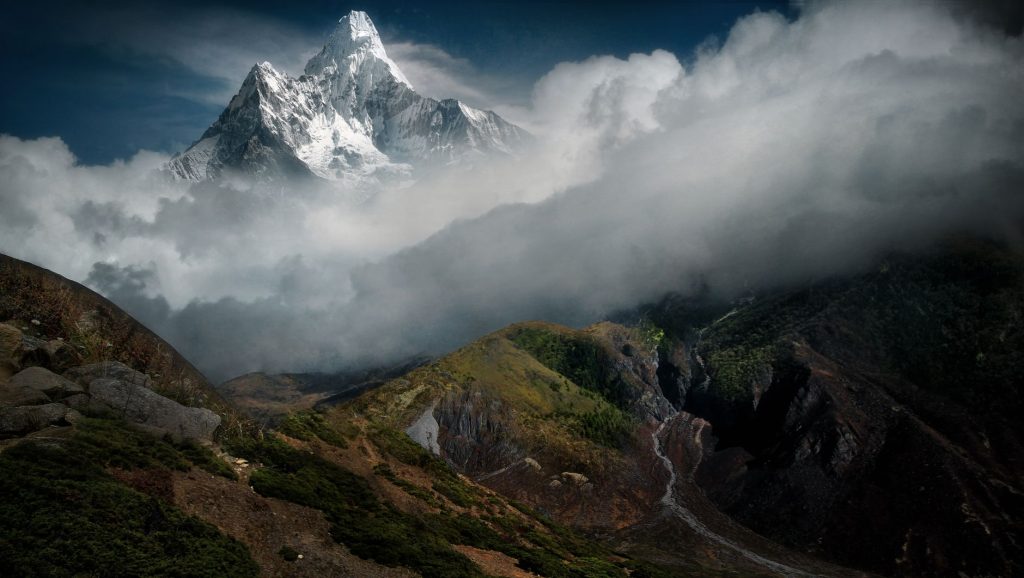
It is worth knowing that you cannot actually see the summit of Everest from Base Camp itself; the Nuptse ridge blocks it. For the iconic view, the pre-dawn climb up Kala Patthar is essential, and it is one of the highlights of the whole trek.

Culture along the trail
Both routes are rich in culture, but of different kinds. The Annapurna foothills are home largely to Gurung and Magar communities, and the trail passes terraced farmland, village schools and homes where daily life carries on around you.
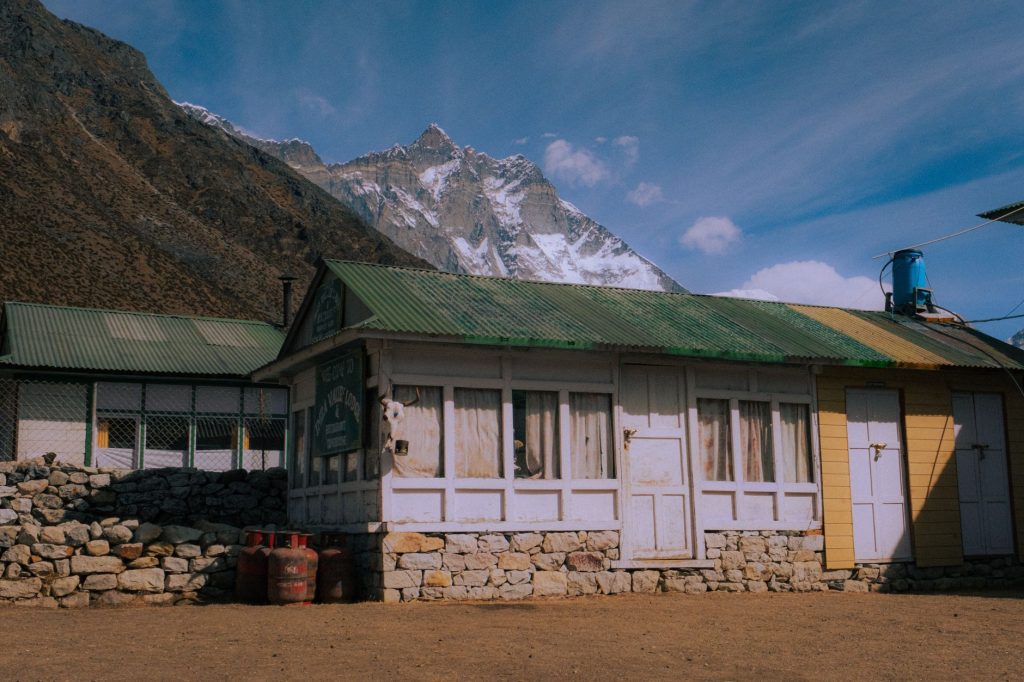
The Khumbu is Sherpa country. Buddhist monasteries, mani walls and prayer wheels line the path, and Tengboche Monastery, framed by Ama Dablam, is one of the great sights of the trek. Namche Bazaar is a bustling trading town with bakeries, gear shops and a Saturday market.
On either trek, much of the pleasure comes from evenings in the lodges, sharing dal bhat and stories with your guide, porters and other trekkers. Hospitality is warm on both sides, and you will leave knowing far more about mountain life than when you arrived.
Logistics, cost and crowds
ABC is simpler to organise. There is no mountain flight to miss, the trailhead is a drive from Pokhara, and the trek fits a two-week holiday with time to spare for paragliding over Phewa Lake afterwards.
EBC depends on Lukla flights, which are weather-dependent and often delayed. In peak season most flights leave from Ramechhap (Manthali), several hours’ drive from Kathmandu, so an early start is unavoidable. Longer duration, the flight and higher lodge prices in the upper Khumbu make EBC the more expensive trek overall.
- Both routes are busiest in October, November, March and April.
- Lodges are generally simpler on the upper ABC trail; Namche and Lukla have more choice.
- Both need a buffer day: ABC for weather on the stairs, EBC for flight delays.

Short on time? If you have under two weeks in Nepal and want a base camp, choose ABC. If you have two and a half weeks or more and altitude excites rather than worries you, EBC is a once-in-a-lifetime walk.
Our verdict
Season matters for both. Autumn and spring give the best conditions; winter is possible on ABC with care around avalanche-prone sections above Deurali, and on EBC with very cold nights. The monsoon brings cloud and rain to both, and the Lukla flights are much less reliable in summer.
Choose Annapurna Base Camp if you want a shorter, greener and more varied trek with lower altitude risk and easy logistics from Pokhara. Choose Everest Base Camp if you want the highest and most famous trail in the world, can give it two weeks and are ready for real altitude. Either way, you will walk into the heart of the Himalaya, and many of our guests come back to do the other one.